
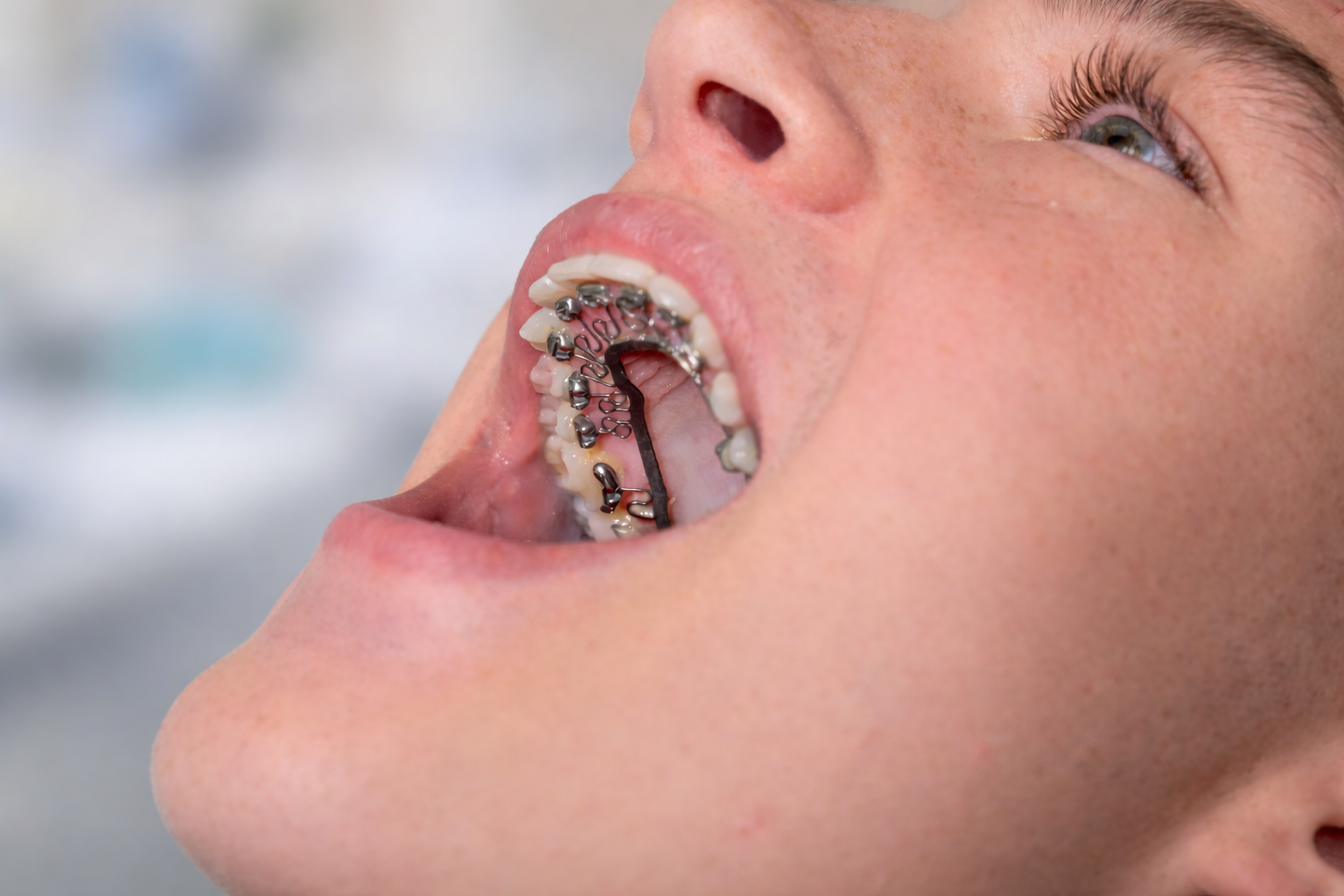
What Are Lingual Braces?
Lingual braces are fixed braces bonded to the tongue side of your teeth instead of the front. The brackets and wire do the same job as conventional appliances — applying steady, controlled force that moves teeth into better positions — but they sit behind the teeth, so almost nobody sees them.
That single difference is why people search for “braces behind teeth” in the first place. Adults in client-facing jobs, teachers, performers, and students who feel self-conscious about metal on the front of their teeth want the mechanical reliability of braces without the visual trade-off. Lingual treatment is one of the few ways to get both.
At ARCH Orthodontics we offer Brava, a lingual system that uses a custom-fabricated appliance and its own digital planning workflow. Because the appliance is made for your anatomy, the fit behind the teeth is far more comfortable than the bulky lingual brackets people remember from decades ago.
How Lingual Braces Actually Work
The biomechanics are familiar. Brackets are bonded to each tooth, a wire connects them, and the wire’s shape and tension guide teeth along a planned path. Your orthodontist adjusts that force at regular visits, and the bone around each root remodels to hold the new position.
What changes with lingual treatment is the geometry. Pushing and pulling from the tongue side means the force vectors are different from a labial (front-side) setup, so treatment planning has to account for that from day one. This is exactly why lingual cases belong with an orthodontist who plans them routinely rather than as an occasional add-on.
Modern lingual systems also lean heavily on digital workflows: an intraoral scan replaces impressions, the appliance is designed against a 3D model of your teeth, and the wires or attachments are produced to match the plan. You can see more of the scanning and imaging equipment we use on our technology page.
Who Is a Good Candidate?
Lingual braces treat a wide range of issues — crowding, spacing, rotations, and many bite problems. Candidacy usually comes down to three practical questions:
- Is there enough tooth surface to bond to? Very short or heavily restored teeth can limit bracket placement. Crowns, veneers, and implants do not rule treatment out, but they change the plan.
- How complex is the bite correction? Some corrections are handled beautifully from the lingual side; others are more efficient with front-side brackets or a hybrid approach.
- How do you feel about the adjustment period? Anything bonded behind the teeth sits near the tongue, and your tongue notices it for a while.
Adults are the largest group choosing lingual treatment, but motivated teens do well with it too. The deciding factor is rarely age — it is whether the case can be finished predictably from behind the teeth.
Lingual Braces vs. Clear Aligners vs. Clear Braces
People shopping for “invisible” options are usually comparing three very different things.
Lingual braces are fixed and hidden. Nothing to remove, nothing to lose, and no compliance question — the appliance works whether or not you remember it exists. That is a real advantage for patients who know they would not wear removable trays for 20 to 22 hours a day.
Clear aligners are removable and nearly invisible from any angle. They are easier to clean around and more comfortable for most people, but they only work while they are in your mouth.
Clear or ceramic braces sit on the front of the teeth with tooth-colored brackets. They are discreet from conversational distance, less hidden than lingual, and often the most straightforward option for complex mechanics.
None of these is universally better. The right answer depends on your bite, your habits, and how much visibility you are willing to accept.
What the First Few Weeks Feel Like
Expect an adjustment period, and expect it to be mostly about your tongue rather than pain.
- Tongue awareness. Your tongue will find the brackets constantly for the first week or two. Most patients stop noticing them by the end of the first month.
- Speech. A slight lisp on “s” and “sh” sounds is common early on and typically resolves as your tongue adapts. Reading aloud for a few minutes a day speeds this up noticeably.
- Soreness. Like any braces, teeth feel tender for a couple of days after placement and after adjustments. Soft foods and over-the-counter pain relief handle it.
- Irritation. Orthodontic wax works behind the teeth exactly as it does in front. If a spot keeps bothering you after a week, call us — a small adjustment usually fixes it permanently.
Cleaning Behind Your Teeth
Hygiene is the part patients underestimate. Plaque behind the lower front teeth is harder to see, so you have to work by feel and habit rather than by mirror.
What works: a soft brush angled toward the gumline from the tongue side, interdental brushes small enough to slip under the wire, a water flosser for quick daily cleanup, and floss threaders when you have the time. Rinse after anything sugary. Keep your regular dental cleanings on schedule during treatment — your general dentist and orthodontist are working on the same mouth, and cleanings matter more while an appliance is in place.
Food rules mirror conventional braces: skip anything hard enough to break a bracket (ice, hard candy, nuts) and anything sticky enough to pull one off (caramel, taffy). Cut apples and corn off the cob rather than biting into them.
Treatment Time and Visits
Lingual treatment timelines are comparable to front-side braces for similar cases — most patients are in active treatment for a period measured in months rather than years, with routine adjustment visits in between. Complex bite corrections take longer regardless of which side the brackets are on.
Two things shorten treatment more than anything else: showing up for scheduled visits, and protecting the appliance. A broken bracket that waits three weeks for repair costs you three weeks.
When active treatment ends, retention begins — and it is not optional. Teeth drift throughout life, which is why a retainer plan follows every case, lingual or not.
Getting a Straight Answer About Your Own Case
The only way to know whether lingual braces suit your bite is an exam with records: photos, a scan, and radiographs, reviewed by an orthodontist who can tell you what is realistic and what the alternatives would look like.
We see patients across the South Shore, Cape, and Boston area, including our Canton and Westwood offices. If hidden treatment is what has been keeping you from starting, bring that up directly at your consultation — request a visit and we will lay out every option your bite allows, including the ones that are not lingual.
Common Questions About Braces Behind the Teeth
Will people be able to tell? From the front, no. Someone looking into your open mouth from close range may see the wire, but in normal conversation lingual braces are effectively invisible.
Do they cost more than regular braces? Usually yes. Lingual appliances are custom-manufactured and the chair time is more technical, so fees run higher than standard metal braces. We quote your case at the consultation and review insurance benefits and monthly payment options before you commit — see our financing page for how that works.
Can I play sports or a wind instrument? Yes to both. A mouthguard is still required for contact sports, and it protects the appliance as well as your lips. Wind and brass players often find lingual brackets easier than front-side brackets because the embouchure surface stays clear, though there is still an adaptation period.
Can lingual braces be combined with other treatment? Often, yes. Some plans use lingual brackets on the upper arch and a different approach below, or start with an appliance to correct a bite issue before bonding brackets. Hybrid plans are common and nothing to be nervous about.
What happens if a bracket comes loose? Call us and keep it in place if it is still attached to the wire. Do not try to reposition it yourself. Loose lingual brackets are less likely to poke you than front-side ones, but they stop treatment progress until they are repaired.